
Contact us
Post contents
In the mid-20th century, Riyadh was a desert village of just 100,000 people. Today, Saudi Arabia is becoming a global laboratory for redefining The very concept of the city.
It’s not just about building glass towers or deploying sensors in the streets, it’s a bold attempt to prove that geography is no longer destiny, and that cities can be designed from scratch to be economic platforms capable of competing with the world’s capitals without inheriting their mistakes.
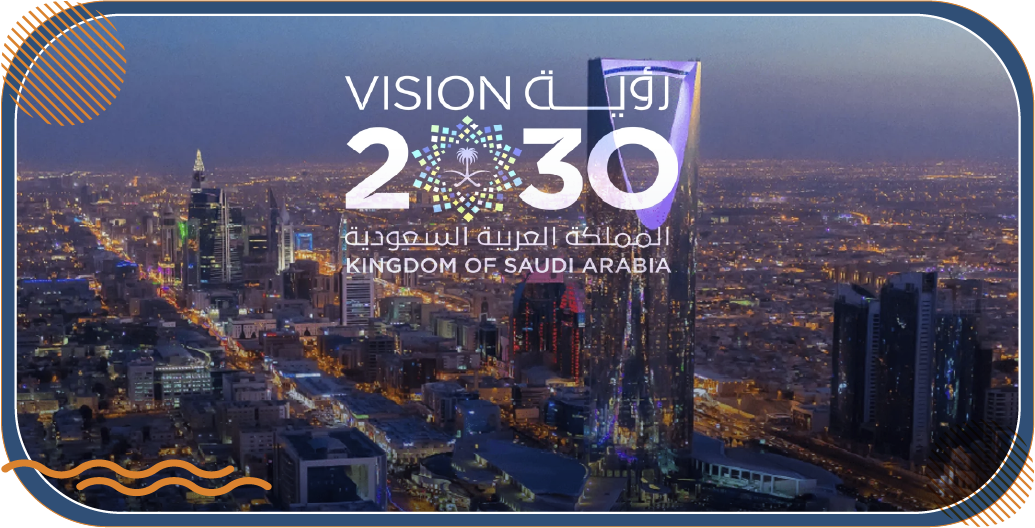
Vision 2030 is not a traditional economic vision, it is an existential bet that the future of the Kingdom will not be built on what’s under the ground in terms of oil, but on what’s above it in terms of brains, networks, and data.
Saudi smart cities are not a technological luxury, but an economic survival strategy in an inevitably post-carbon world.
Smart cities: Beyond silicon and screens
When we talk about smart cities, images of energy-efficient LED-lit streets or apps that track public transportation buses often come to mind. But this narrow definition misses the essence of the idea. In its deepest sense, a smart city is an urban ecosystem that learns, adapts, and responds to the needs of its residents in real time, using AI, IoT, and big data.
The technical dimension is obvious: Sensors on every street, self-driving transportation systems, smart power grids that predict demand and automatically distribute the load. But the economic dimension is more profound: Smart cities are centers of attraction for global talent, incubators for startups, platforms for experimenting with new business models in a flexible regulatory environment. The human dimension is the most dangerous and most neglected: How do you design a city that balances efficiency and privacy, innovation and cultural identity, speed and sustainability?
This is the question Saudi Arabia is trying to answer over an area larger than Belgium.
Saudi experience: Ambition as a strategy
What characterizes the Saudi approach to building smart cities is the sheer audacity to experiment without the constraints of urban legacy. When you build a city from scratch, you don’t have to rehabilitate 19th-century sewage systems or negotiate with fragmented landowners. This is a rare geopolitical advantage that the Kingdom has brilliantly exploited.
- Neum It’s not just a city, it’s a virtual economic state covering 26,500 square kilometers. The project poses a radical idea: What if we redesigned the city so that rentier capitalism (real estate) is not the primary driver, but innovation and productivity?
NEOM promises an autonomous legal system, special visas, tax breaks, and a regulatory environment that treats AI and robots as full economic citizens. - The Line Even more challenging: A linear city 170 kilometers long and only 200 meters wide, with no cars and no streets, where all services are a 5-minute walk away. The idea subverts traditional urban architecture based on horizontal and vertical sprawl, proposing a third model: Linear, multi-layered sprawl. The success or failure of this model will be written in the urban planning books for the next century.
- Kadia It bets on the entertainment and sports economy, a sector the region has neglected for decades. An entertainment city the size of an entire metropolitan area, capable of welcoming 17 million visitors annually, is a bet that the new generation of Saudis (70 percent of whom are under 35) will not accept the traditional lifestyle.
- King Abdullah Economic City On the Red Sea, it is trying to become an alternative logistics gateway to Dubai, with a port with a capacity of 25 million containers, connected to smart industrial and logistics zones.
These are not isolated projects, but carefully placed chess pieces on a map that aims to transform the Kingdom from a mono-economy (oil) to a polycentric economy (tourism, industry, logistics, technology, entertainment).
Redefining concepts: From theory to practice
Quality of life as a competitive benchmark
Saudi smart cities have “quality of life” as a key performance indicator, a radical shift in a management culture that once measured success by the number of towers or the length of roads. NEOM promises that 95% of nature will be preserved and the air will be 20 times cleaner than traditional cities. The Line completely eliminates noise pollution with the absence of cars.
Sustainability as an economic imperative
All projects are entirely based on renewable energy. NEOM will be powered entirely by solar and wind energy, with plans to produce green hydrogen for export. This is not an environmental luxury, but a strategy to ensure operational costs are sustainable as carbon prices rise globally.
Artificial Intelligence as a backbone
Cities will be run by AI systems that predict traffic, manage energy consumption, monitor air quality, and even suggest improvements to urban planning itself. Data will be collected from millions of sensors, then analyzed to optimize everything from the timing of traffic lights to the distribution of parks.
Smart Mobility as an Alternative to Individual Ownership
The Line eliminates the idea of car ownership, relying on an autonomous underground transportation network. NEOM is investing in long-distance flying cars. Qiddiya integrates cable car and funicular systems into the same entertainment design.
Economic impact: Beyond the numbers
Talk of $500 billion in investments in NEOM alone sounds amazing, but the real impact is deeper. These cities are creating whole new markets: A market for smart buildings, for autonomous drones, for decentralized energy systems, for vertical farming, for quantum computing, for biotechnology.
More than that, smart cities are redistributing the economic geography of the Kingdom. For decades, the economy was centered in Riyadh and Dammam (oil and government). Now, Tabar, NEOM and Qiddiya are creating new centers of gravity on the west and north coast, close to Europe and Africa, turning the Kingdom into a true continental bridge.
The impact on investment attraction is clear: Major global tech companies are opening regional headquarters in Riyadh, not only to serve the Saudi market, but also to use Saudi Arabia as a testing ground for technologies that cannot be tried in Europe or Asia due to regulatory restrictions.
Social impact: What’s Not Easily Measured
The real shift is not in infrastructure, but in culture. Car-free cities mean more physically engaged communities. Cities that run entirely on clean energy raise a generation that sees sustainability as a standard, not an option. Cities that employ robots in services are asking questions about the future of work and the skills required.
But the biggest challenge socially is community adoption. A smart city without residents who embrace its intelligence is just a technology museum. Will Saudis accept a life without private cars? Will they trust systems that collect their data to improve their services? This is a bet on cultural change that takes generations.
Challenges: The road is not paved
The enormous cost is the first challenge. NEOM alone costs more than the budgets of entire countries. Funding is partly dependent on the Public Investment Fund and oil, creating a paradox: Financing a post-oil future with oil money.
Technical infrastructure takes years to build and test. Cybersecurity in data-driven cities is not a luxury but an essential defensive fortress. A single successful cyberattack on a water or energy management system could paralyze an entire city.
Talent is scarce. Building cities of this complexity requires thousands of engineers specializing in technologies that have yet to be tested on this scale. Saudi Arabia imports talent, but localizing it is a strategic challenge.
And finally, the risk of a “bubble”: Building huge cities without real economic demand can create luxury ghost cities. This is what happened in some Chinese experiments. Success depends on attracting real residents and investors, not curious tourists.
Global comparison: Singapore and Dubai as mirrors
Singapore built its urban intelligence over 50 years with gradualism and strict discipline. Dubai jumped from a fishing village to a global city in 30 years thanks to boldness and location. Saudi Arabia is trying to combine: Dubai’s speed with Singapore’s discipline, but on a much larger scale.
The decisive difference: Singapore has no natural resources, so it was forced to be smart. Dubai has limited oil, so it was forced to diversify. Saudi Arabia has massive oil, but voluntarily chooses to transform, which is psychologically and politically more difficult.
Conclusion: When a nation bets on the future
Saudi Smart Cities are not just urban projects, they are a philosophical bet that the future is not to be waited for, but created. In a rapidly urbanizing world (70% of humanity will live in cities by 2050), whoever owns the successful city models will own the economic and cultural clout.
Related Posts
In the mid-20th century, Riyadh was a desert village of just 100,000 people. Today, Saudi Arabia is becoming a global laboratory for redefining The very concept of the city.
It’s not just about building glass towers or deploying sensors in the streets, it’s a bold attempt to prove that geography is no longer destiny, and that cities can be designed from scratch to be economic platforms capable of competing with the world’s capitals without inheriting their mistakes.
Vision 2030 is not a traditional economic vision, it is an existential bet that the future of the Kingdom will not be built on what’s under the ground in terms of oil, but on what’s above it in terms of brains, networks, and data.
Saudi smart cities are not a technological luxury, but an economic survival strategy in an inevitably post-carbon world.
Smart cities: Beyond silicon and screens
When we talk about smart cities, images of energy-efficient LED-lit streets or apps that track public transportation buses often come to mind. But this narrow definition misses the essence of the idea. In its deepest sense, a smart city is an urban ecosystem that learns, adapts, and responds to the needs of its residents in real time, using AI, IoT, and big data.
The technical dimension is obvious: Sensors on every street, self-driving transportation systems, smart power grids that predict demand and automatically distribute the load. But the economic dimension is more profound: Smart cities are centers of attraction for global talent, incubators for startups, platforms for experimenting with new business models in a flexible regulatory environment. The human dimension is the most dangerous and most neglected: How do you design a city that balances efficiency and privacy, innovation and cultural identity, speed and sustainability?
This is the question Saudi Arabia is trying to answer over an area larger than Belgium.
Saudi experience: Ambition as a strategy
What characterizes the Saudi approach to building smart cities is the sheer audacity to experiment without the constraints of urban legacy. When you build a city from scratch, you don’t have to rehabilitate 19th-century sewage systems or negotiate with fragmented landowners. This is a rare geopolitical advantage that the Kingdom has brilliantly exploited.
- Neum It’s not just a city, it’s a virtual economic state covering 26,500 square kilometers. The project poses a radical idea: What if we redesigned the city so that rentier capitalism (real estate) is not the primary driver, but innovation and productivity?
NEOM promises an autonomous legal system, special visas, tax breaks, and a regulatory environment that treats AI and robots as full economic citizens. - The Line Even more challenging: A linear city 170 kilometers long and only 200 meters wide, with no cars and no streets, where all services are a 5-minute walk away. The idea subverts traditional urban architecture based on horizontal and vertical sprawl, proposing a third model: Linear, multi-layered sprawl. The success or failure of this model will be written in the urban planning books for the next century.
- Kadia It bets on the entertainment and sports economy, a sector the region has neglected for decades. An entertainment city the size of an entire metropolitan area, capable of welcoming 17 million visitors annually, is a bet that the new generation of Saudis (70 percent of whom are under 35) will not accept the traditional lifestyle.
- King Abdullah Economic City On the Red Sea, it is trying to become an alternative logistics gateway to Dubai, with a port with a capacity of 25 million containers, connected to smart industrial and logistics zones.
These are not isolated projects, but carefully placed chess pieces on a map that aims to transform the Kingdom from a mono-economy (oil) to a polycentric economy (tourism, industry, logistics, technology, entertainment).
Redefining concepts: From theory to practice
Quality of life as a competitive benchmark
Saudi smart cities have “quality of life” as a key performance indicator, a radical shift in a management culture that once measured success by the number of towers or the length of roads. NEOM promises that 95% of nature will be preserved and the air will be 20 times cleaner than traditional cities. The Line completely eliminates noise pollution with the absence of cars.
Sustainability as an economic imperative
All projects are entirely based on renewable energy. NEOM will be powered entirely by solar and wind energy, with plans to produce green hydrogen for export. This is not an environmental luxury, but a strategy to ensure operational costs are sustainable as carbon prices rise globally.
Artificial Intelligence as a backbone
Cities will be run by AI systems that predict traffic, manage energy consumption, monitor air quality, and even suggest improvements to urban planning itself. Data will be collected from millions of sensors, then analyzed to optimize everything from the timing of traffic lights to the distribution of parks.
Smart Mobility as an Alternative to Individual Ownership
The Line eliminates the idea of car ownership, relying on an autonomous underground transportation network. NEOM is investing in long-distance flying cars. Qiddiya integrates cable car and funicular systems into the same entertainment design.
Economic impact: Beyond the numbers
Talk of $500 billion in investments in NEOM alone sounds amazing, but the real impact is deeper. These cities are creating whole new markets: A market for smart buildings, for autonomous drones, for decentralized energy systems, for vertical farming, for quantum computing, for biotechnology.
More than that, smart cities are redistributing the economic geography of the Kingdom. For decades, the economy was centered in Riyadh and Dammam (oil and government). Now, Tabar, NEOM and Qiddiya are creating new centers of gravity on the west and north coast, close to Europe and Africa, turning the Kingdom into a true continental bridge.
The impact on investment attraction is clear: Major global tech companies are opening regional headquarters in Riyadh, not only to serve the Saudi market, but also to use Saudi Arabia as a testing ground for technologies that cannot be tried in Europe or Asia due to regulatory restrictions.
Social impact: What’s Not Easily Measured
The real shift is not in infrastructure, but in culture. Car-free cities mean more physically engaged communities. Cities that run entirely on clean energy raise a generation that sees sustainability as a standard, not an option. Cities that employ robots in services are asking questions about the future of work and the skills required.
But the biggest challenge socially is community adoption. A smart city without residents who embrace its intelligence is just a technology museum. Will Saudis accept a life without private cars? Will they trust systems that collect their data to improve their services? This is a bet on cultural change that takes generations.
Challenges: The road is not paved
The enormous cost is the first challenge. NEOM alone costs more than the budgets of entire countries. Funding is partly dependent on the Public Investment Fund and oil, creating a paradox: Financing a post-oil future with oil money.
Technical infrastructure takes years to build and test. Cybersecurity in data-driven cities is not a luxury but an essential defensive fortress. A single successful cyberattack on a water or energy management system could paralyze an entire city.
Talent is scarce. Building cities of this complexity requires thousands of engineers specializing in technologies that have yet to be tested on this scale. Saudi Arabia imports talent, but localizing it is a strategic challenge.
And finally, the risk of a “bubble”: Building huge cities without real economic demand can create luxury ghost cities. This is what happened in some Chinese experiments. Success depends on attracting real residents and investors, not curious tourists.
Global comparison: Singapore and Dubai as mirrors
Singapore built its urban intelligence over 50 years with gradualism and strict discipline. Dubai jumped from a fishing village to a global city in 30 years thanks to boldness and location. Saudi Arabia is trying to combine: Dubai’s speed with Singapore’s discipline, but on a much larger scale.
The decisive difference: Singapore has no natural resources, so it was forced to be smart. Dubai has limited oil, so it was forced to diversify. Saudi Arabia has massive oil, but voluntarily chooses to transform, which is psychologically and politically more difficult.
Conclusion: When a nation bets on the future
Saudi Smart Cities are not just urban projects, they are a philosophical bet that the future is not to be waited for, but created. In a rapidly urbanizing world (70% of humanity will live in cities by 2050), whoever owns the successful city models will own the economic and cultural clout.